

Intelligent technical documentation platform.
Upload meeting recordings, documents and other files. rivvn.ai transcribes them, interprets the context with specialised artificial intelligence agents and produces structured technical documentation to accelerate software development.
rivvn.ai is compatible with the leading AI models, such as Claude, GPT and Gemini, and uses the architecture best suited to each scenario.
Less time documenting. More time developing.
- 95%
- reduction in the time needed to produce technical documentation.
- 98%
- faster than manual writing by a senior developer.
- 30
- specialised agents working collaboratively.
- US$ 65.8k
- in scope gaps identified during projects.
The challenges of technical documentation
Documenting software by hand means spending time organising information that changes every day. By the time the documentation is finally ready, it no longer reflects the reality of the project.
Documentation that slows development down
While requirements and specifications are organised manually, teams wait for information before they can move the project forward.
Knowledge lost between meetings
Important decisions end up scattered across calls, emails and conversations, making it hard to keep development on track.
Gaps discovered too late
Inconsistencies go unnoticed during planning and only surface once they have already hit schedule, cost or quality.
Spot impacts before they turn into rework.
Before development starts, rivvn.ai analyses the dependencies between requirements, components, services and APIs, identifying the potential impact of changes and helping teams decide with greater predictability.
Compliance built into documentation from day one.
GDPR and ISO 27001 stop being checks carried out only at audit time. rivvn.ai takes these requirements into account throughout the documentation, helping to flag points of attention and keep security, privacy and compliance requirements traceable across the whole project.
Turn meetings into technical documentation with artificial intelligence
See how rivvn.ai turns meetings, documents and technical knowledge into structured documentation, using an architecture made up of specialised AI agents.
- 01
Capture and transcription
Meetings, documents, spreadsheets, files and other sources are brought together to build the full context of the project.
- 02
Understanding the context
The agents analyse requirements, business rules and technical information to organise knowledge and identify relationships in the data.
- 03
Intelligent analysis
The platform identifies inconsistencies, gaps, dependencies and improvement opportunities before they affect development.
- 04
Documentation generation
The agents work together to produce requirements, technical specifications and other structured, ready-to-use artefacts.
- 05
Review and validation
The generated documentation goes through an audit layer that checks consistency, completeness, applicability and traceability, increasing the reliability of the documents.
Meet Supero Atlas
Supero Atlas is the specialised intelligence that powers rivvn.ai. Developed by Grupo Supero, it is trained to interpret requirements, technical specifications, business rules and the other information that makes up a system’s documentation, supporting the agents as they analyse and generate technical documentation.
Trained on thousands of real projects
Built with technical documentation from software projects to understand patterns, requirements and contexts that general-purpose AI models do not know.
Dedicated infrastructure. Your data stays under control.
Servers in Europe, in Germany, on dedicated infrastructure, or on-premises environments, for greater security, governance and compliance in enterprise operations.
Average quality of generated documentation
Documents produced by Supero Atlas are automatically assessed against criteria such as completeness, consistency, applicability and traceability. Scale 0–100.
Everything you need to document more intelligently
rivvn.ai uses specialised agents to turn meetings, documents and technical knowledge into structured documentation. While it organises information, flags risks and connects project knowledge, your team gains the speed to develop with more confidence.
- 01
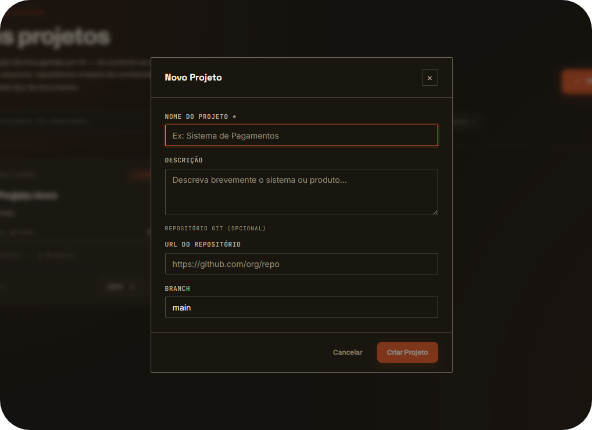
Documentation ready to accelerate development
Upload recordings, documents and other project files. rivvn.ai transcribes them, interprets the context and produces requirements, technical specifications and structured artefacts in minutes.
- 02
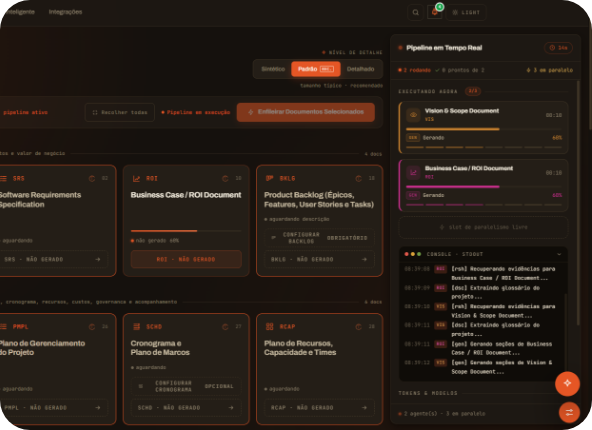
30 specialised agents. One shared context.
Each agent is responsible for one stage of analysing, interpreting and structuring the documentation, working in coordination to produce more complete and consistent results than a single AI model.
- 03
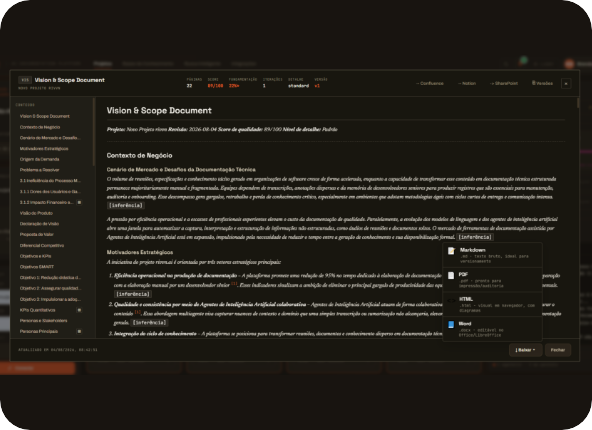
Spot impacts before they turn into rework
Before development starts, rivvn.ai analyses dependencies, identifies the potential impact of changes and helps teams decide with greater predictability.
- 04
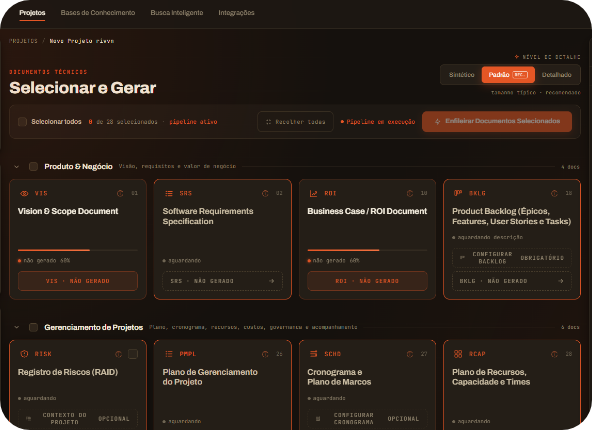
Compliance built in from the start
GDPR and ISO 27001 stop being checks carried out only at audit time. rivvn.ai supports the generation of documentation aligned with compliance requirements throughout the project.
- 05
Knowledge that stays with the project
Meetings, technical decisions, requirements and business rules are no longer scattered across people and tools. Knowledge is organised into structured documentation, making it easier to consult, evolve the software and keep teams in continuity.
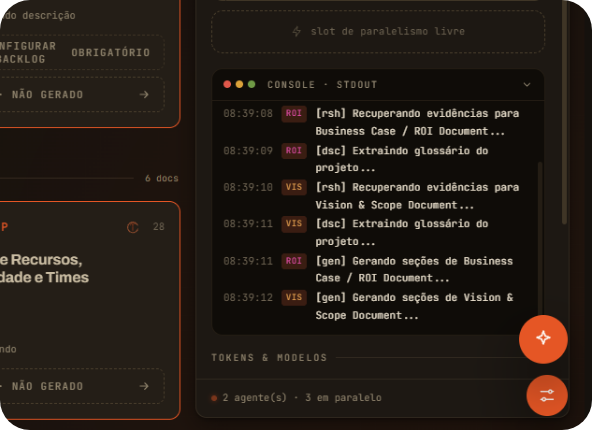
30 agents. Parallel intelligence. Zero gaps.
Each agent is a deep specialist in its field, anchored to an industry standard. They work in parallel, coordinated by a state-graph orchestrator, with an automated reviewer and a grounding verifier ensuring quality and accuracy.
Vision & Scope
Vision, scope and success criteria: the executive alignment of the project.
Requirements · SRS IEEE 29148
Traceable functional and non-functional requirements, use cases and traceability matrix.
Technical architecture · Arc42 + C4
Layers, components, C4 diagrams and architectural decisions.
ADRs · MADR
Immutable architectural decisions: context, alternatives, consequences.
API contract · OpenAPI 3.1
Endpoints, schemas, authentication and errors, extracted from the actual code handlers.
Data model · ER + Dictionary
Tables, fields and relationships from the ORM and migrations, with an ER diagram.
Test strategy · ISO 29119
Test levels, coverage, BDD, acceptance criteria and QA strategy.
Deploy & ops runbook · SRE
Build, deploy, configuration, rollback and operations: the end of tribal knowledge.
Security & Compliance · OWASP ASVS
Security controls and policies ready for due diligence.
Business case · ROI
CAPEX, OPEX, TCO, payback and return analysis.
User documentation · Diátaxis
Tutorial, how-to, reference and explanation: the four modes, never mixed.
Changelog · Keep a Changelog
Per-release history and semantic versioning, drawn from the project and Git.
Repository Overview
A dense technical wiki of the code: structure, entry points and flows. Onboarding in hours, not days.
Impact analysis · Git
Cross-checks the proposed change against the real repository: blast radius by file:line, risk and effort.
GDPR compliance
Records of processing, DPIA, legal bases and international transfers mapped.
Threat model · STRIDE + OWASP
Real attack surface, prioritised threats and mitigations anchored in the code.
Risk register · RAID / ISO 31000
Risks, assumptions, issues and dependencies, both technical and project-level.
Product backlog · Epic to Story
Epic → Feature → Story → Task, Gherkin acceptance criteria, ready for Jira/Azure.
SoA ISO 27001:2022
The 93 Annex A controls with applicability, status and evidence in the code.
SAP BPD · Business Process Design
AS-IS/TO-BE process, roles, data, integrations and fit-gap, aligned with SAP Activate.
SAP functional spec · RICEFW
Rules, screens, fields, validations, authorisations and functional acceptance.
SAP technical spec · Clean ABAP
ABAP objects, DDIC/CDS/RAP, classes, performance, tests and transports.
RICEFW/WRICEF catalogue
Reports, interfaces, conversions, enhancements, forms and workflows with priority and owner.
Test plan & UAT
SIT, UAT, regression, test data, defects and sign-off.
Cutover & transports
Transport sequence, go/no-go, rollback, communication and hypercare.
Management plan · PMBOK
Scope, governance, deliverables, changes, quality and acceptance in one integrated plan.
Schedule & milestones · CPM + Scrum
Baseline, releases, sprints, critical path, buffers and early signs of delay.
Resources & capacity · RACI
Roles, skills, RACI matrix, allocation, bottlenecks and operating model.
Costs & budget · EVM
Baseline, CapEx/OpEx, forecast, earned value and FinOps.
Stakeholders & communication
Influence matrix, reporting cadence and escalation plan.
LangGraph state graph · 9 nodes
Resolves contradictions between the 30 agents and propagates changes automatically across all related artefacts.
4 criteria, closed loop
Scores completeness, consistency, applicability and traceability (0–100). A score below the threshold triggers automatic refinement.
Auditable anti-hallucination
Every factual statement is classified against the evidence: supported, partial, unsupported or contradicted. Whatever does not hold up is corrected, and the document ships with an audit appendix.
- Mermaid
- BDD Given/When/Then
- OpenAPI 3.1
- Data Dictionary
- Image generation
- Compliance Matrix
rivvn.ai connects to the environment your team already works in.
Bring project information and documentation into the tools that are part of your operations, connecting rivvn.ai to the main development, collaboration and management environments.












More agility in documenting. More confidence in developing.
From requirements gathering to the continuous evolution of software, rivvn.ai helps teams produce more consistent technical documentation, reducing rework, preserving knowledge and speeding up decisions across the whole development lifecycle.
Requirements gathering
Support requirements engineering by turning meetings, interviews and workshops into structured documentation ready for development.
Software engineering
Produce technical specifications, requirements and artefacts that support teams throughout the project.
Systems modernisation
Document legacy applications and preserve technical knowledge to ease upgrades, migrations and maintenance.
Impact analysis
Understand how changes may affect requirements, dependencies and components before development begins.
Compliance and governance
Produce documentation aligned with GDPR and ISO 27001 requirements, strengthening traceability and audit.
Knowledge management
Centralise decisions, business rules and project information in one place, reducing reliance on individual knowledge.
Frequently asked questions about intelligent technical documentation
How rivvn.ai uses artificial intelligence and specialised agents to turn meetings, documents and technical knowledge into structured documentation, reducing rework and accelerating software development.
What is rivvn.ai?
rivvn.ai is an intelligent technical documentation platform that uses specialised artificial intelligence agents to turn meetings, documents and other information sources into structured documentation for software projects.
How does it turn meetings into technical documentation?
The platform analyses meeting recordings, documents, spreadsheets and other project files. From this information, specialised agents interpret the context, identify requirements, connect information and produce structured technical documentation.
Which documents can it generate?
rivvn.ai supports the generation of functional requirements, technical specifications, project documentation and other artefacts used throughout the software development lifecycle.
How do specialised agents differ from traditional generative AI?
While traditional models respond to a single prompt, rivvn.ai uses specialised agents that work in coordination to interpret information, validate context, identify gaps and produce more consistent documentation.
Does it help identify inconsistencies and gaps in requirements?
Yes. While analysing the information, the platform identifies missing requirements, inconsistencies, dependencies and potential impacts, reducing rework and supporting safer decisions.
Can it support compliance initiatives?
Yes. The platform supports processes that require documentation aligned with requirements such as GDPR and ISO 27001, strengthening the traceability and governance of information.
Does it replace analysts or software architects?
No. The platform aims to automate operational tasks and support specialists in producing, validating and evolving technical documentation, so teams can spend more time on strategic decisions.
Can it be used on existing projects?
Yes. The platform supports new projects, maintenance initiatives, systems modernisation and the evolution of existing applications, organising knowledge and keeping documentation up to date throughout the development lifecycle.
Bring the intelligence of rivvn.ai to your project.
Explore the platform, meet the specialised agents and see how rivvn.ai can accelerate your project’s technical documentation.
Request a demoWhere applied innovation meets execution.
We apply our experience in complex operations to solve real bottlenecks and deliver measurable impact.
- Grupo Supero × QualittiGas distribution
AI and LiDAR
For one of Brazil’s leading bottled-gas distributors, an AI solution based on LiDAR that enables self-service points of sale, with stock control and validation between payment and collection.
- Grupo Supero × QualittiSteel industry
Computer vision and Safety 4.0
For one of the world’s leading steel groups, a computer vision and AI system that detects signs of fatigue and drowsiness in overhead crane operators in real time.
- Grupo Supero × QualittiIndustry · Operational safety
Industrial PPE Checkpoint
A cross-platform app with facial recognition and PPE checklists at industrial access points: an 80% reduction in entries without PPE.
- QualittiSmart city · Urban mobility
Gomoov
An app for renting electric vehicles integrated with public transport, with delivery offers from local merchants during journeys.
- QualittiEnergy · Distribution
AI for default prediction and predictive debt collection
Machine learning models that predict default risk and tailor the tone, channel and timing of debt collection.
- QualittiEnergy · Distribution
Intelligent customer prioritisation for power restoration
A dynamic multi-criteria index to prioritise restoration after grid failures, with real-time data for crew dispatch.
Connect with our specialists and take innovation where it creates real impact.
Get in touch